 |
Positional Accuracy Standards for Digital Geospatial Data
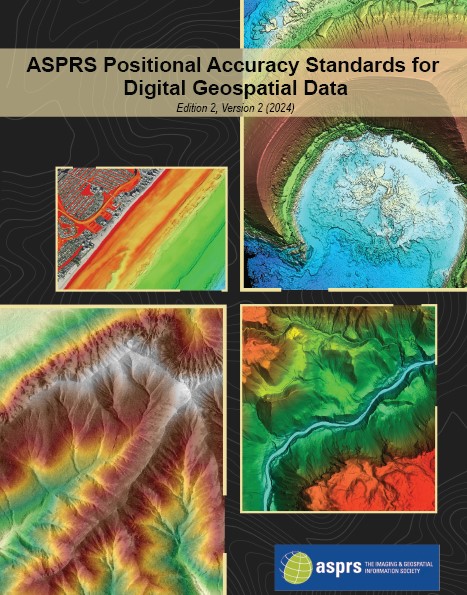
ASPRS Positional Accuracy Standards for Digital Geospatial Data, Edition 2, Version 2 (2024).
Edition 1 of the ASPRS Positional Accuracy Standards for Digital Geospatial Data was published in November 2014. In the years since, users expressed concerns and suggested revisions based on their experience applying the Standards in real-world situations. In addition, technologies have evolved in such a way as to challenge the assumptions upon which Edition 1 was based.
In 2022, ASPRS established a formal Positional Accuracy Standards Working Group under the Standards Committee to evaluate user comments, consider technology advancements, and implement appropriate changes to the Standards. The following individuals were appointed to the Positional Accuracy Standards Working Group:
Chair: Dr. Qassim Abdullah, Vice President and Chief Scientist, Woolpert, Inc.
Members:
• Dr. Riadh Munjy, Professor of Geomatics Engineering, California State University, Fresno
• Josh Nimetz, Senior Elevation Project Lead, U.S. Geological Survey
• Michael Zoltek, National Geospatial Programs Director, GPI Geospatial, Inc.
• Colin Lee, Photogrammetrist, Minnesota Department of Transportation
The ASPRS Positional Accuracy Standards for Digital Geospatial Data are developed based on industry consensus. They are designed to be modular in nature, such that revisions can be made and additional sections added as geospatial technologies and methods evolve. Additionally, the Standards are designed to recommend best practices, methods, and guidelines for the use of emerging technologies to achieve the goals and requirements set forth in the Standards. With support from the ASPRS Technical Divisions, the primary Working Group established subordinate Working Groups to author Addenda for best practices and guidelines for photogrammetry, lidar, UAS, and field surveying. The subordinate Working Group members and contributors are credited in each Addendum.
|
| PAS2024 |
 |
Landsat's Enduring Legacy
Landsat's Enduring Legacy: Pioneering Global Land Observations from Space
After more than 15 years of research and writing, the Landsat Legacy Project Team has published, in collaboration with the American Society for Photogrammetry and Remote Sensing (ASPRS), a seminal work on the nearly half-century of monitoring the Earth's lands with Landsat. Born of technologies that evolved from the Second World War, Landsat not only pioneered global land monitoring but in the process drove innovation in digital imaging technologies and encouraged development of global imagery archives. Access to this imagery led to early breakthroughs in natural resources assessments, particularly for agriculture, forestry, and geology. The technical Landsat remote sensing revolution was not simple or straightforward. Early conflicts between civilian and defense satellite remote sensing users gave way to disagreements over whether the Landsat system should be a public service or a private enterprise. The failed attempts to privatize Landsat nearly led to its demise. Only the combined engagement of civilian and defense organizations ultimately saved this pioneer satellite land monitoring program. With the emergence of 21st century Earth system science research, the full value of the Landsat concept and its continuous 45-year global archive has been recognized and embraced. Discussion of Landsat's future continues but its heritage will not be forgotten.
The pioneering satellite system's vital history is captured in this notable volume on Landsat's Enduring Legacy.
Member/Non-Member Price: $48.00
Student Member Price: $36.00
To receive the student member price, please enter the promotional code "LANDSATSTUDENT" on the checkout page. NOTE - this discount will only be applied if you are a current student member of ASPRS.
|
| 4958 |
 |
Airborne Topographic Lidar Manual - Hardcover
The ASPRS Airborne Topographic Lidar Manual coves all the relevant topics relating to the science behind lidar systems, mission planning, data collection and management, quality control/quality assurance, and product development. Selected topics are discussed in-depth for the Global Navigation Satellite System, Full Waveform Lidar, Digital Terrain Modeling using GIS, Rotary-Wing and Fixed-Wing Installations, Calibration, Flood Prone Area Mapping, Hydro-enforcement, Building Feature Extraction, Transportation Engineering, Natural Hazards Mapping, and Airport Surveying.
This book is also available on Kindle
through Amazon at
http://www.amazon.com/dp/B00E3FWBO6.
Non-Member Price: $150.00
Member Price: $95.00
Student Price: $75.00
To receive the student rate, enter the Promotional code STUDBOOK on the cart checkout page (restricted to Student Members only)
*The softcover version is also available at https://my.asprs.org/ItemDetail?iProductCode=LIDARPAPER
|
| 4587 |
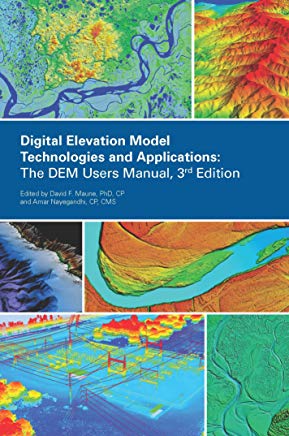 |
Digital Elevation Model Technologies & Applications, 3rd Ed
Available on Paperback
The Kindle version can be purchased here: https://a.co/d/f3ksK4L.
The 3rd edition of the DEM Users Manual includes 15 chapters, three appendices and a detailed Index: References in the eBook version are hyperlinked. Chapter and appendix titles include:
1. Introduction to DEMs
David F. Maune, Hans Karl Heidemann, Stephen M. Kopp, and Clayton A. Crawford
2. Vertical Datums
Dru Smith
3. Standards, Guidelines & Specifications
David F. Maune
4. The National Elevation Dataset (NED)
Dean B. Gesch, Gayla A. Evans, Michael J. Oimoen, and Samantha T. Arundel
5. The 3D Elevation Program (3DEP)
Jason M. Stoker, Vicki Lukas, Allyson L. Jason, Diane F. Eldridge, and Larry J. Sugarbaker
6. Photogrammetry
J. Chris McGlone and Scott Arko
7. IfSAR
Scott Hensley and Lorraine Tighe
8. Airborne Topographic Lidar
Amar Nayegandhi and Joshua Nimetz
9. Lidar Data Processing
Joshua M. Novac
10. Airborne Lidar Bathymetry
Jennifer Wozencraft and Amar Nayegandhi
11. Sonar
Guy T. Noll and Douglas Lockhart
12. Enabling Technologies
Bruno M. Scherzinger, Joseph J. Hutton, and Mohamed M.R. Mostafa
13. DEM User Applications
David F. Maune
14. DEM User Requirements & Benefits
David F. Maune
15. Quality Assessment of Elevation Data
Jennifer Novac
Appendix A. Acronyms
Appendix B. Definitions
Appendix C. Sample Datasets
In 2013, the U.S. Geological Survey (USGS) initiated the 3D Elevation Program (3DEP) to provide not just bare earth DEMs, but a full suite of 3D elevation products using Quality Levels (QLs) that are standardized and consistent across the U.S. and territories. The 3DEP is based on the National Enhanced Elevation Assessment (NEEA) which evaluated 602 different mission-critical requirements for and benefits from enhanced elevation data of various QLs and update frequencies for 34 Federal agencies, all 50 states (with local and Tribal input), and 13 non-governmental organizations. The NEEA documented the highest Return on Investment from QL2 lidar for the conterminous states, Hawaii and U.S. territories, and QL5 IfSAR for Alaska.
USGS’ Lidar Base Specification (LBS) is now used nationwide to produce standardized and consistent topographic lidar of all QLs, and Chapters 1, 3, 5, 8, 9, 13, 14, and 15 are “must-read” chapters for users and providers of topographic lidar data. Chapter 8 addresses linear mode, single photon and Geiger mode lidar technologies, and Chapter 10 addresses the latest in topobathymetric lidar. The remaining chapters are either relevant to all DEM technologies or address alternative technologies including photogrammetry, IfSAR, and sonar.
As demonstrated by the figures selected for the front cover of this manual, readers will recognize the editor’s vision for the future a 3D Nation that seamlessly merges topographic and bathymetric data from the tops of the mountains, beneath the rivers and lakes, to the depths of the sea.
David F. Maune, PhD, CP, CFM, PSM, PS, GS, SP
Amar Nayegandhi, CP, CMS-Remote Sensing
Co-Editors
PRICING
ASPRS Individual Members: $80
Non-members: $90
ASPRS Student Members: $70 (CLICK HERE TO ORDER, must submit a copy of your student ID to be eligible for student pricing)
|
| 4959 |
 |
MRS Vol. 1.1 Earth Observing Platforms & Sensors
Stock # 4582
This volume of the Manual of Remote Sensing series,
Volume 1.1: Earth Observing Platforms Sensors, updates the previous CD-ROM database of sensors and platforms with an interactive online database and adds chapters of context for major
families of sensors and platforms. The intent of this volume is to enable all who have an interest in remote sensing -- from student to researcher to practitioner -- to see what the possibilities are, how the field has developed and where it is going.
The past several years have witnessed proliferation of the use and awareness of remotely sensed imagery in research fields not traditionally concerned with geospatial technologies and by the general public for an ever-expanding variety of tasks. The chapters of this volume do not seek to address all possible uses for remotely sensed data. The goal is to provide a starting point for anyone
searching for a greater understanding of what has, can and may be done using remote sensors for Earth observation. Following a brief history of key developments in remote sensing and related technologies, the chapters introduce the reader to the basics of the broad sensor families and types and conclude with chapters on the related in situ sensors and a look at the future of spaceborne remote sensing.
The accompanying website (accessible at www.asprs.org)
is designed to provide basic information about as many sensors and platforms as possible, while also pointing to additional sources of information on the web and in technical and scholarly publications. ASPRS members are invited to help maintain and expand the data in this database as a community resource.
Table of Contents
- Timeline of Key Developments in Platforms and Sensors for Earth Observations
- Basics of Remote Sensing Systems
- Thermal Remote Sensing: Theory, Sensors, and Applications
- Terrestrial Laser Ranging: Current Capabilities and Future Directions
- Hyperspectral Remote Sensing • Sensors and Applications
- Microwave Sensors • Active and Passive
- Space-Based Platforms and Sensors
- In situ Sensors and Field Methods
- The Current Status and Future Direction of Spaceborne Remote Sensing Platforms and Imaging Systems
INSTRUCTORS MAY REQUEST AN EXAMINATION
COPY FOR THIS TITLE.
Non-Member Price: $95.00
Member Price: $75.00
Student Price: $55.00
To receive the student rate, please contact the ASPRS Office at (301) 493-0290 or at [email protected].
|
| 4582 |
 |
MRS Vol. 6 Remote Sensing of the Marine Environment
Stock # 4578
This book is a comprehensive, up-to-date resource for oceanographers and marine scientists interested in applications of satellite imagery and other
remote sensing techniques to studying and monitoring ocean and coastal waters. The volume is organized for quick access to topics of particular
interest, with chapters on ocean productivity, circulation, pollution, wind, planetary waves, sea ice and coastal processes. The first chapter reviews
the history of satellite observations of the ocean, noting the contribution from different countries and the interactions of military and civilian interests.
Printed in color throughout, with Internet sources, helpful illustrations and extensive references, this volume is a major resource for researchers and
practitioners working in marine environmental science.
INSTRUCTORS MAY REQUEST AN EXAMINATION COPY FOR THIS TITLE.
Chapters
- A History of Oceanography from Space
- Large-scale Ocean Circulation
Remote Sensing of Extra-equatorial Planetary Waves
Global- and Ocean-scale Primary Production from Satellite Observations
Measuring Ocean Surface Wind from Space
Coastal Physical and Biochemical Processes
Remote Sensing of Marine Pollution
Sea Ice Monitoring by Remote Sensing
Toward a Global Ocean System for Measurements of Optical Properties Using Remote Sensing and In Situ Observations
Non-Member Price: $95.00
Member Price: $75.00
Student Price: $50.00
To receive the student rate, please contact the ASPRS Office at (301) 493-0290 or at [email protected].
|
| 4578 |
 |
MRS Vol. 5 Remote Sensing of Human Settlements
Stock # 4576
Volume 5 addresses human settlement as an ecosystem where humans and the natural environment are interacting, from the smallest village to the complex
metropolis. Comprehensive, authoritative, and up-to-date, it covers the history of remote mapping of settlements, remote sensing theories and methods, applying remotely sensed data through various techniques, and a look at emerging trends and future challenges. Intended for use by researchers, educators,
and students, as well as to provide some encouragement for urban and regional planners to explore the use of the technology to advance their missions. Section I covers historical highlights for mapping settlements from the 19th century to the present. Section II presents thematic applications in
population estimates, human health, and more. Section III presents selected forward-looking thematic challenges to the remote sensing community. Chapter authors and contributors to this volume are leaders in
this field.
Chapters
- Historical Evolution and Mapping of Human Settlements
- Principles and Tools for Remote Sensing of Human Settlements
- Characterizing and Mapping Human Settlements
- Image Processing Methods
- Information Extraction
- Estimating Population and Census Data
- Satellites, Settlements, and Human Health
- Remote Sensing of Natural and Man-made Hazards and Disasters
- Archeological Remote Sensing of Early Human Settlements
- Documenting Dynamics of Human Settlements
- Current Research and Future Directions in the application of Remote Sensing to Human Settlements
- New and Emerging Instruments and Some Emerging Trends for Remote Sensing of Human Settlements
INSTRUCTORS MAY REQUEST AN EXAMINATION
COPY FOR THIS TITLE.
Non-Member Price: $99.00
Member Price: $80.00
Student Price: $60.00
To receive the student rate, please contact the ASPRS Office at (301) 493-0290 or at [email protected].
|
| 4576 |
|
Airborne Topographic Lidar Manual - Paperback
The ASPRS Airborne Topographic Lidar Manual coves all the relevant topics relating to the science behind lidar systems, mission planning, data collection and management, quality control/quality assurance, and product development. Selected topics are discussed in-depth for the Global Navigation Satellite System, Full Waveform Lidar, Digital Terrain Modeling using GIS, Rotary-Wing and Fixed-Wing Installations, Calibration, Flood Prone Area Mapping, Hydro-enforcement, Building Feature Extraction, Transportation Engineering, Natural Hazards Mapping, and Airport Surveying.
This book is also available on Kindle
through Amazon at
http://www.amazon.com/dp/B00E3FWBO6.
Non-Member Price: $125.00
Member Price: $85.00
Student Price: $70.00
To receive the student rate, enter the Promotional code STUDBOOK on the cart checkout page (restricted to Student Members only)
*The Hardcover is available here: https://my.asprs.org/ItemDetail?iProductCode=4587
|
| LIDARPAPER |
 |
Manual of Geographic Information Systems
Stock #4650
The Manual of Geographic Information Systems
is the latest addition to the rich collection of ASPRS manuals. Until now;
however, there has never been a manual devoted to geographic information systems
(GIS). This volume is designed to be a comprehensive resource on GIS for
students, researchers and practitioners who are interested in asking spatial
questions, assessing landscapes, building geodatabases and envisioning a world
of integrated geospatial technologies.
The book has been organized in eight major sections: Background and Overview; Data Models, Metadata and Ontology; GIS Data
Quality and Uncertainty; Spatio-Temporal Aspects of GIS; Analysis and Modeling; Blending GIS with Remote Sensing, GPS and Visualization; GIS and the World Wide
Web and GIS Applications. Top researchers in GIS from around the world, along with emerging scholars, have told the story of a discipline that originated
alongside advances in computer technology and is increasingly incorporated into our daily lives. The wide range of topics covered in the 62 chapters of this
volume attest to the role GIS plays in blurring the boundaries between traditional photogrammetry, remote sensing, land surveying, geodesy,
cartography, and computer science. The Manual of Geographic Information Systems provides a conceptual framework for data connected to location, the
language needed for spatial conversation and analysis tools for discovery of geographic place, proximity, dimensions, trends and correlations.
The DVD
that accompanies this book contains more than 300 color figures plus digital content contributed by leading GIS companies, agencies and institutions
including, ESRI; ERDAS; SAIC; IVS 3D; NOAA; USGS; San Diego State University; University of California, Santa Barbara; University of Plymouth; Florida State
University; University of Georgia; and, State University of New York College of Environmental Science and Forestry.
INSTRUCTORS MAY REQUEST AN EXAMINATION
COPY FOR THIS TITLE.
| |